Monday, March 11, 2019

Following the last trail of Ernest Shackleton


MEN WANTED for hazardous journey, small wages, bitter cold, long months of complete darkness, constant danger, safe return doubtful, honor and recognition in case of success.  ...or so the advertisement by Shackleton went,  who would place such an ad?

ERNEST SHACKLETON was without a doubt one of the craziest thrill seekers of his generation.  probably the last of his kind following in the footsteps of Scott and Amundson.  Involved with the early attempts to reach the south pole, he held for a time the distinction of being the the person to have stood the farthest south on Earth.  Roald Amundson broke that record in 1911, reaching the pole and from that point on, Shackleton concentrated on being the first person to cross Antarctica on foot.
He is most famous for his Endurance voyage of 1914-17, which ended when the ship got stuck in pack ice and was destroyed leaving the crew to encamp on the ice until it melted and then he with four people was forced to sail in a small boat 700 nautical miles to South Georgia island in a converted 20 foot life raft, and encountering a storm so fierce it sunk other larger ships in nearby waters, but this was his only plan to get help.  The final leg, was a tough 36 hour crossing of the island to a whaling station on the other side overland using only a 50 foot piece of rope.  It became the end of his most famous journey.  In fact, even the crossing of South Georgia was not undertaken again for 40 years when a more modern explorer did it.  “I do not know how they did it, except they had to.”  Was a quote from Duncan Carse, the only other man to have done what Shackleton did.  Shackleton then organized the rescue of everyone in his expedition
Shackleton was listless and unhappy away from his exploring and by 1921, after some work in the Russian Civil War, he was ready to head south again, for another attempt to cross Antarctica, but he never made it to the southernmost continent.  This time fate took him and he died of a heart attack in Grytviken Harbor in January 5, 1922.  He was five weeks short of his 48th birthday.
It was two months over 97 years later that I followed in his footsteps and on march 10, landed in Grytviken harbor.  The place was now as much of a historical preservation location as the whaling station had been closed 50 years previous.  The wholesale slaughter of blue whales thankfully ended.
Shackleton’s body made it’s way to Montevideo, Uruguay where we started our trip in the southern hemisphere before a message from his wife requesting that he be buried in South Georgia was received.  The body was brought back to the island aboard the steamer Woodville and buried on March 5th, 1922.  The Boss as he was known would only have been happy being buried at a place near where he finished one of his greatest exploits.  Unlike everyone else in the cemetery 
Yesterday, we toasted the great explorer, dumping a little Jameson Whiskey out for "The Boss"
Olaf and Captain Debien toasting Shackleton at a graveside ceremony, five days late of the 97th anniversary of his burial

The views of South Georgia when the sun is out (and that is about 20% of the time) is stunning.  The island has sheer snow capped mountain precipices, and fjords, and is surrounded by occasional iceberg.  We spent parts of three days exploring it, which unfortunately for me was somewhat limited as I had picked up a virus from some passenger and I was nursing a fever and bronchitis while we were there. 
It is true that I frequently say, the birding must go on, and it did, although at one stunning backdrop our trip to shore was without me, I stayed aboard ship, helped an elderly German man with his camera, and scoped snowy sheathbills from my balcony.  Hopefully not sharing my virus, but hard to tell.  But I got out and tallied all the birds I needed, finally helping my friends get them all too.  It was a potpourri of southern species

Antarctic terns

Napping Chinstrap penguin, Penguin #6 for trip

Snowy sheathbill, which are really odd birds, sort of related to sandpipers

I found this endemic South Georgia diving petrel when the crew was preparing the ship for incredible rough seas ahead.  We got him out before he would be crushed by huge swells breaking in the foredeck.  I did a good deed and also got a lifer bird.  I saw more later off the deck, but I almost got blown overboard

South Georgia pipit

South Georgia shag

Antarctic prion

Southern giant petrel, white phase

Black bellied storm petrel

Gray headed albatross

Gray petrel

light mantled albatross

Northern giant petrel

Sooty albatross

soft plumaged petrel

Except for not seeing a snow petrel off the huge iceberg, on our final pass out of South Georgian waters I got all the birds I needed to get here.  With that I still left something for next time.  Snow petrel will have to wait for another time

There were other sights to see around South Georgia Island
HMS Clyde at Grytviken

view of Grytviken


Leopard seal before he attacked a zodiac

Fur seal pup
Glacier at Larsen Bay

Yesterday was the best day all year in South Georgia, but alas, not today, today we are sailing into the unknown, through this fjord  and into 50 mph winds, the ship is listing due to the wind.  The captain secured everything, as 8 meter waves crash on the foredeck, as we head to Trisdan de Cuhna, I'm drinking and it isn't even noon yet.  I'm not drinking due to lifer bird although I got the diving petrel today, but because I'm a little scared, and even I put a patch on, the first time I have since my 2013 voyage to Attu.

Farthest point south in my life just at 55 degrees, which a few minutes later matched the wind speed

Waves are breaking on top of 6th deck, and so for now, I must sign off, 

Olaf from the South Atlantic


Thursday, March 7, 2019

Desire the Right

In 1596 a British Sailor named John Davis aboard the Desire spotted for the first time the Falkland Islands.  It was nearly 80 years later when another Brit, a man named John Strong actually landed on the island, and curiously the first settlement on the island was by a French Explorer, a man named Bougainville in 1765.  British troops in 1832 and 1833 removed an Argentine occupation and began a 185 year protest by the Argentines as to the rightful ownership of the islands, which remain British, despite a 1982 war.
       The British Overseas territory now has the motto "Desire the Right" in honor of that first ship firmly stated on their flag which also has the Union Jack and a sheep on it.  The are 3400 residents and many tens of thousands of sheep that make the island home.
       With this in mind, three days ago, our expedition mad four stops on the islands, on the islands of New Island, West Falkland, and Saunders island, all remote places.  We met the owner of Dunbar Farm, a French woman named Mary Paul who came to the southern ocean to live on a sail boat and ended up buying a 12,000 acre sheep farm, that features 4500 sheep, 6 dogs, and thousands of penguins.  The owner is a relative of a crew member on the ship.
.
She described her ordeal of living here and the local people.  I also had a nice chat with David, the owner of Saunders island, on the beach.  We talked about the island and their experiences during the war, which never really came to their side of the islands, although there was a plan by the Argentines to round up and kill all of them, they were ready to at least try to give themselves a sporting chance with the firearms they had at that farms, but suspected they'd end up being bombed.  Luckily that never happened.  They feel the dispute is far from over.

My wife was looking at the "gift shop' the back of a Defender FWD vehicle and this is the last picture picture of her carbon fiber walking stick, she left it leaning against the back of the Land Rover 

 We did buy a nice hat.  We were more worried about the wet landing to get back to the ship, in which the waves went over our boots, oh well, at least we got some use out of it
 They even rent out this little shack.  It is currently rented to four Germans for the week, Oddly, it is booked until 2023.  I guess this is a destination.  It looks a bit bleak for a destination vacation.  Maybe the inside is nicer.

The weather was true Falklands, rain, sun, and wind up to 40 mph, it changed every hour on the hour.   It was a place that before this, was only on the map.  This wasn't a bucket list item, but seeing penguins were.  We saw five species of Penguins.
gentoo penguin

king penguin

macaroni penguin

Magellanic penguin

Southern rockhopper penguin

They were all cool birds and we saw their breeding areas, the gentoo chicks were the most active walking up to you and giving you a weird look or they were heading off into the sea

There were some other cool birds around
Black chinned siskin, this was the only one seen

blackish cinclodes (tussuckbird)

Blackish oystercatcher

brown skua

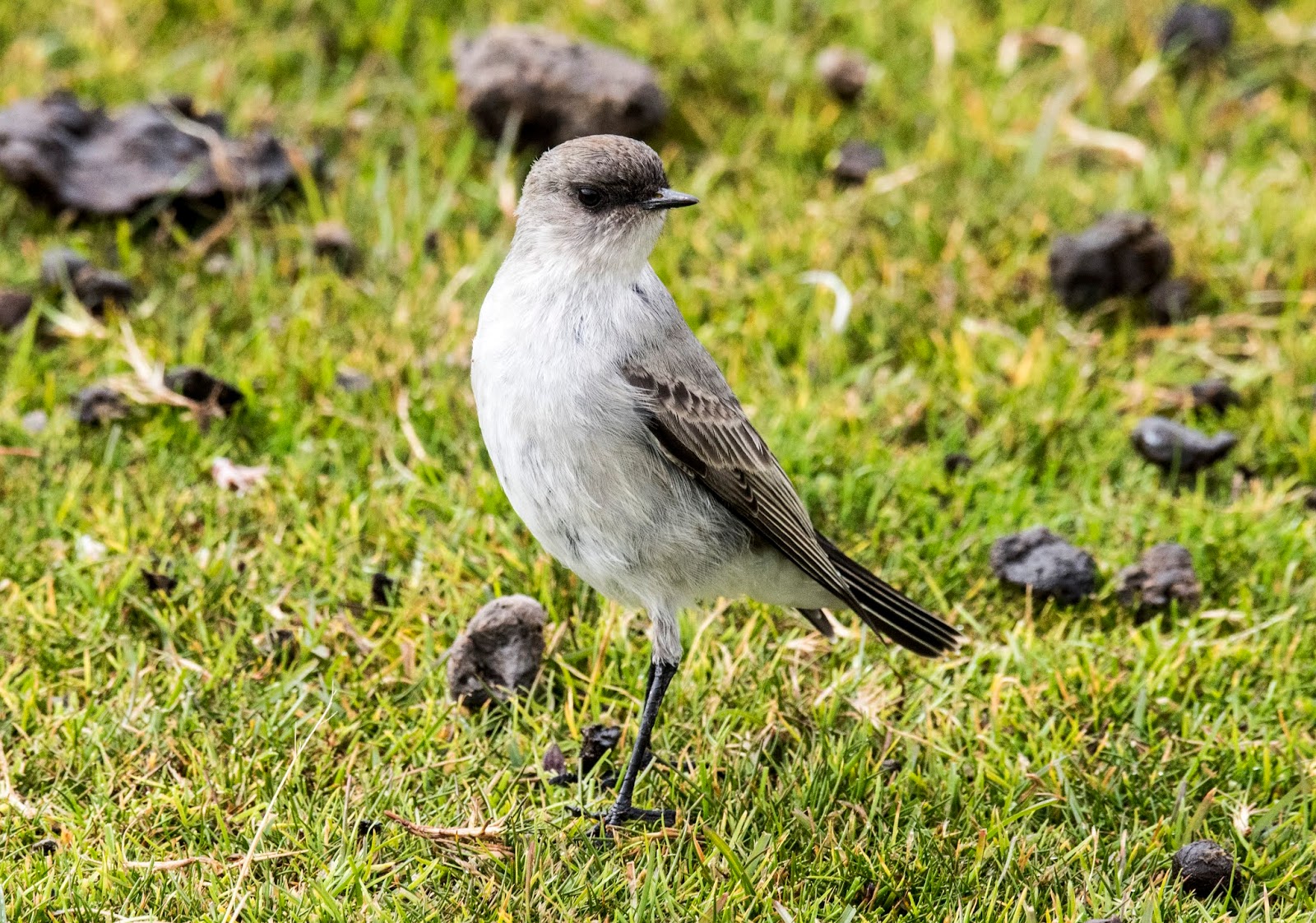
Dark faced ground tyrant which I also saw on the ship, as 3 flew out and cruised around for a couple of days

falkland steamer duck, it was cool to see them "steam", as they are flightless and kick up water like steam when they are chasing each other

Magellanic oystercatcher

Striated caracara

sadly, we did not go to anyplace that had the endemic Cobb's wren, which is either a species or a subspecies of House wren, but as I said, one cannot get them all and we did pretty good, I'm now at 141 lifer additions, but the question is, how can I drink that much beer?  This is a French  boat and they mostly have wine but all in all.  It was a good visit, save for the walking stick.  Some different views with us in them


Now it is off to South Georgia, cruising into the high seas of the Roaring 40s,  
I'll be on point watching for cool seabirds and trying to stay warm exposed on the deck to the cold winds of the south Atlantic.  I'll be desiring my own right----identifying the right Giant petrel, are they northern or southern, and the right and correct albatross, Royals or wandering, or the right prion, only God can identify prions and as I said, below 50 there is no God, so I guess even He doesn't know

Cheers, 
Olaf


Monday, March 4, 2019

The End of the Earth

Ushuaia, Argentina
This city is the second farthest south inhabited village on the planet Earth, it is called the end of the road as, Argentina Route 3, ends a little west of the city.  It was founded in 1884, except that when it was founded, 300 people already lived there as British missionaries had come 15 years earlier.  It is hard to know what is anti-British propaganda and what is real in Argentina.  The Argentines still claim the Malvinas are theirs despite the fact that they lost a war over them and almost all of the residents of the Falklands voted to stay British.  The Argentines claim the vote was rigged and have signs like this on busses, in the airport, on the roads, in the stores, and on the schools
We did not come down here the solve political issues, we came down here to bird and to connect with our trans-Atlantic expedition aboard the LeLyrial, a French ship making an expedition west.

It had rained in this southern terminus of America for something like 50 days.  It was 48 degrees as it was always 48 degrees here in the summer, before winter comes in a month or so and they get three feet of snow.  For us, the weather cleared and it made for great birding.  We spent 48 hours searching the few miles of roads and hiking the trails in the park here which at the few vistas was ran over with buses of day trip tourists from cruise ships.  We met lots of European youth on Patagonia hikes and camping trips but on the trails we found not a single human.  This was great as it didn't take us very long to find one of the most sought after birds in the Americas...the Magellanic woodpecker.  In fact, we saw three.

An impressive bird and the single thump of the male on a tree was the loudest thing i'd ever heard.

We then stumbled upon the local hummer, a green-backed firecrown, which when I heard the chirp, made me think, a hummer...here...?  But then we finally saw it and got a photo.
We then made a list, to find, searched for habitat and started ticking birds...

austral parakeets

long-tailed meadowlark

Magellanic oystercatcher

I spotted my lifer penguin, a Magellanic penguin

They have cool geese and ducks down here including this strange flightless steamer duck

they still have glaciers here...

 cool cormorants like this imperial cormorant

 with over thirty lifer birds in 48 hours it was finally time to find our ship, the La Lyrial, for what the captain called an expedition. The captain greeted us by saying...'Below 40 degrees south there is no law; below 50 degrees south there is no God'
The La Lyrial at port, Ushuaia, March 2, 2019

We would be sailing the Roaring 40s, and as the Bad weather man currently having nice weather, was it the calm before the storm?  At least we would eat well, it turned out the captain of our liferaft was the head chef who was introduced as the most important person on a French ship, but who would save the wine?  There have been other ships to sail from here, The HMS Beagle twice.
           When the then 44-year old light cruiser the ARG General Balgrano left port in Ushuaia, Argentina in April 26, 1982, it had already had a long history.  The ship formerly known as  the USS Pheonix had been at port in Pearl Harbor on December 7, 1941 when the Japanese attacked and it was not hit.  It survived the entire war receiving nine battle stars and then in 1948 was sold to the Argentine Navy.
            On March 3, 2019, our ship the Le Lyrial, entered the Beagle Channel (one of the three passages between the the Atlantic and Pacific Oceans and exited it into the Atlantic ocean just as the Belgrano did bound northeastward towards the Falkland Islands and the start of our expedition and a trans Atlantic croissing.
            Back in 1982, what happened next will always be under some dispute.  The Belgrano stopped south of the Falklands and patrolled with three other ships and was monitored by a British submarine.  A few days later, an order was given by the Argentine admiral that the ship would support military action in Falklands which had been invaded a month earlier, and then fearful of this, the British attacked the ship and it was hot by two torpedoes and sunk, just under 300 Argentines died as a result.  About half of the casualties of the entire Falklands War.  A few months later, the British retook control of the Island group and Argentina left in failure.  
           well, it was good to leave Argentina for us, no matter what happens as our travelling companions, Don and Nancy broke their bathroom, due to a towel drier incident, and it was only a matter of time before our car's brakes failed and we'd roll down a hill into a shop.
Even my penguin Leroy after trying to fly in Buenos Aires, and I was just able to catch him in the nick of time...
Learned that the local ships had some other issues, he is a troublesome penguin...
that Leroy....hopefully he'll keep us out of trouble, as he went birding with us the day we got the hard to get woodpeckers so he has been lucky in the field, but he just hikes a little slow.

I hope our ship has a better fate.

Olaf

MR 2000

  What is in a number?  For a listing birder, numbers seem to be everything, but in reality, it is deeply personal, because in the end, it d...